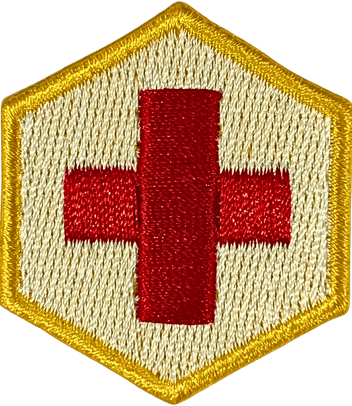
First Aid
From Discover to Reflect
Every Saints Global badge follows the same arc — learn it, plan it, do it, then reflect on what changed.
- Step 1 · DISCOVER
Discover
Learn what this badge is really about.
Explain the priorities of first aid (scene safety, patient assessment, and getting help) and why shock and airway problems are life-threatening emergencies.
Define triage and describe two situations where triage decisions may be required.
- Step 2 · PLAN
Plan
Get ready — gather what you need.
Explain how to obtain emergency medical assistance from home and from a remote or wilderness location, including what information must be given.
Assemble a personal first-aid kit suitable for outdoor activity and explain the purpose of each item.
- Step 3 · ACT
Act
Do the work, in the real world.
Demonstrate a complete primary and secondary assessment of an injured patient, including airway, breathing, circulation, and a head-to-toe exam.
- Scene safety scan: identify hazards and state what makes the scene safe to enter.
- Primary assessment (ABC): check responsiveness, airway, breathing, and circulation; identify life threats.
- Secondary assessment: head-to-toe exam and SAMPLE history (Signs/Symptoms, Allergies, Medications, Past history, Last intake, Events).
- Document or verbally report findings in correct order to the leader.
Demonstrate proper infection-control precautions, including glove use and disposal of contaminated materials.
- Demonstrate proper hand hygiene before and after care.
- Put on and remove gloves without contaminating yourself.
- Use barrier methods appropriately (mask/CPR barrier) when indicated.
- Show safe disposal of contaminated items (bagging, sharps awareness) and cleaning of reusable gear.
Demonstrate first aid for bleeding wounds, including direct pressure, bandaging, and correct tourniquet placement without tightening.
- Apply direct pressure and elevate/position appropriately while maintaining patient safety.
- Apply a pressure bandage correctly and reassess bleeding control.
- Demonstrate wound packing technique on a trainer or simulated wound (if available).
- Explain when tourniquets are appropriate and not appropriate; list benefits and dangers.
- Place a tourniquet correctly on a limb trainer without tightening; state where it should be placed and what to record/communicate.
Demonstrate first aid responses for breathing emergencies such as choking, asthma attack, and anaphylaxis.
- Choking: demonstrate correct response for a conscious victim and describe response if victim becomes unconscious.
- Asthma attack: identify key signs and demonstrate supportive first aid (positioning, assisting with prescribed inhaler if available, monitoring).
- Anaphylaxis: identify signs and demonstrate supportive first aid (activate EMS, position, assist with auto-injector trainer if available, monitor airway).
- Inhalation injury: identify signs and demonstrate safe actions (move to fresh air if safe, activate EMS, monitor breathing).
- Altitude illness: describe signs and demonstrate first aid priorities (rest, descend, hydrate as appropriate, monitor).
Demonstrate CPR using an approved training device and explain when CPR and AED use are appropriate.
- Explain conditions required before starting CPR (unresponsive, not breathing normally) and activating EMS.
- Demonstrate high-quality CPR on an approved manikin (rate, depth, full recoil, minimal interruptions).
- Demonstrate AED steps with a trainer: power on, attach pads, clear for analysis, clear for shock, resume CPR.
- Identify typical AED locations in your community (school/place of worship/sports facility) and explain why those locations are chosen.
Demonstrate bandaging and splinting for at least three injuries (sprain, fracture, dislocation) using proper materials and technique.
- Explain differences between strain, sprain, dislocation, simple fracture, and open/compound fracture.
- Demonstrate an arm sling and swathe for forearm/upper arm/collarbone support.
- Demonstrate an elastic wrap/cravat bandage for an ankle sprain.
- Demonstrate an elastic wrap/cravat bandage for a wrist sprain or hand injury.
- Demonstrate splinting procedure for one suspected fracture/dislocation: finger/toe, forearm/wrist, upper leg, or lower leg/ankle (choose at least one).
Demonstrate safe methods for moving an injured patient, including a one-person drag, two-person carry, and improvised stretcher.
- Explain conditions under which an injured person should and should not be moved.
- Demonstrate a one-person drag suitable for smoke-filled room conditions (practice simulation).
- Demonstrate a two-person carry for a patient with a sprained ankle for at least 25 yards (or simulated distance if space-limited).
- Improvise a stretcher with helpers under your supervision and move a patient for at least 25 yards (or simulated distance if space-limited).
- Describe spinal precautions and when to avoid movement unless necessary for safety.
- Step 4 · REFLECT
Reflect
Look back and see what changed.
Explain which first aid skill was most difficult to perform and how repeated practice improved your confidence and effectiveness.
Describe how first aid knowledge enables you to better serve family, neighbors, and community in moments of crisis.
Take it with you
Download the official sheets — bring them to council meetings, advisor check-ins, and badge submissions.
Requirements Sheet
Printable BRC checklist for the Saint to track and submit.
DownloadLeader Guide
Teaching outline, lesson prep, and discussion notes.
DownloadActivity Pack
Hands-on activities and printables to pair with the requirements.
DownloadJunior Activity Pack
Single-session Junior Saints activities and printables.
DownloadGold Card
Wallet-sized completion summary for the sash holder.
DownloadLeader Key
Verification criteria and answer key for advisors.
DownloadKeep building
For the Saint who learns to work with their hands and hold their own outdoors.


Log requirements in the portal
Members track progress, submit completion, and request advisor sign-off through the Saints Global member portal.