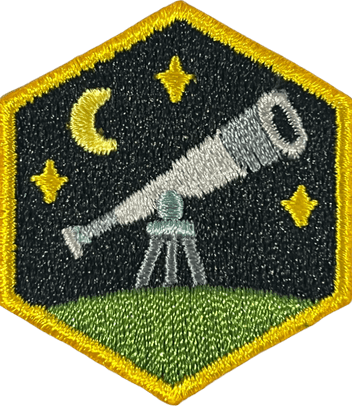
Astronomy
To develop wonder, precision, and disciplined scientific thinking through safe sky observation, use of optical tools, mapping and identification of celestial objects, and clear explanation of what is being seen and why.
From Discover to Reflect
Every Saints Global badge follows the same arc — learn it, plan it, do it, then reflect on what changed.
- Step 1 · DISCOVER
Discover
Learn what this badge is really about.
Explain the likely hazards of astronomy activities (night travel, weather, wildlife, dehydration, equipment hazards) and describe how you will prevent and respond to them.
Demonstrate first aid knowledge for observation-related risks (heat/cold reactions, dehydration, bites/stings, and eye injury), and explain proper clothing and precautions for night and cold-weather observing.
Explain what light pollution is, how it affects astronomy, and describe one practical action you can take to protect or improve the night sky in your community.
Explain how to observe the Sun safely (including eclipses) and demonstrate correct solar-safety rules and equipment boundaries.
- Step 2 · PLAN
Plan
Get ready — gather what you need.
Explain why binoculars and telescopes are important tools, compare at least two telescope types (including one non-optical wavelength telescope conceptually), and describe the purpose of three common telescope accessories or instruments.
Prepare an observation plan that lists target objects, tools to be used (naked eye/binoculars/telescope/app/chart), and the safety and setup steps for the session.
- List at least 10 targets spanning at least three categories (constellations/stars/Moon/planets/deep-sky/satellites)
- Identify how each target will be located (chart/app/star-hop/finder)
- Describe site selection and light discipline
- List setup, alignment, and shutdown steps for your equipment
List the five most visible planets and explain which can show phases like the Moon and why; describe how planets move across the sky including retrograde motion at a high level.
- Step 3 · ACT
Act
Do the work, in the real world.
Under the natural night sky, identify 10 constellations (including at least four zodiac constellations) and eight conspicuous stars (including at least five of magnitude ~1 or brighter) and show them to a leader.
Make two direct-observation sketches of the Big Dipper or Cassiopeia showing orientation change, including the North Star and the horizon.
- Create two sketches from direct observation at different times
- Label North Star and horizon features
- Explain why the pattern appears to rotate
Observe one planet and describe what you saw, including color, brightness, steadiness, and any visible phase or disk (if equipment allows).
Create a 12-month evening-sky visibility chart for the five visible planets using approved resources, and explain how you decided what ‘observable’ means for your location.
Sketch the Moon and label five maria (seas) and five craters from observation, then explain how the Moon’s phases and eclipses relate to Sun–Earth–Moon positions.
- Produce a labeled Moon sketch based on observation
- Make four separate observations of the Moon’s phase and position and sketch each with horizon landmarks
- Explain new/quarters/full and how lunar vs solar eclipses occur
Explain the Sun’s composition and how it compares to other stars, define sunspots, and identify one red, one blue, and one yellow star (other than the Sun) and explain what the colors mean.
Complete one outreach or extended observing option: host a star party, assist a public star party, visit an observatory/planetarium and report, complete an extended observation session beyond the basics, or produce a labeled image series of celestial motion.
- Choose one option with leader approval and explain your plan beforehand
- Demonstrate or present at least 10 additional objects or a labeled motion series/report
- Explain what worked, what was difficult, and how you kept the activity safe
- Teach at least one concept to another person during the activity
- Step 4 · REFLECT
Reflect
Look back and see what changed.
Explain what the Milky Way is and what we are seeing when we look at it, and describe one way astronomy deepened your sense of wonder and responsibility.
Identify three astronomy-related career pathways or hobby pathways and describe the training, costs, and next steps for one you might pursue.
Take it with you
Download the official sheets — bring them to council meetings, advisor check-ins, and badge submissions.
Requirements Sheet
Printable BRC checklist for the Saint to track and submit.
DownloadLeader Guide
Teaching outline, lesson prep, and discussion notes.
DownloadActivity Pack
Hands-on activities and printables to pair with the requirements.
DownloadJunior Activity Pack
Single-session Junior Saints activities and printables.
DownloadGold Card
Wallet-sized completion summary for the sash holder.
DownloadLeader Key
Verification criteria and answer key for advisors.
DownloadKeep building
For the Saint who learns to think clearly and judge wisely.








Log requirements in the portal
Members track progress, submit completion, and request advisor sign-off through the Saints Global member portal.